

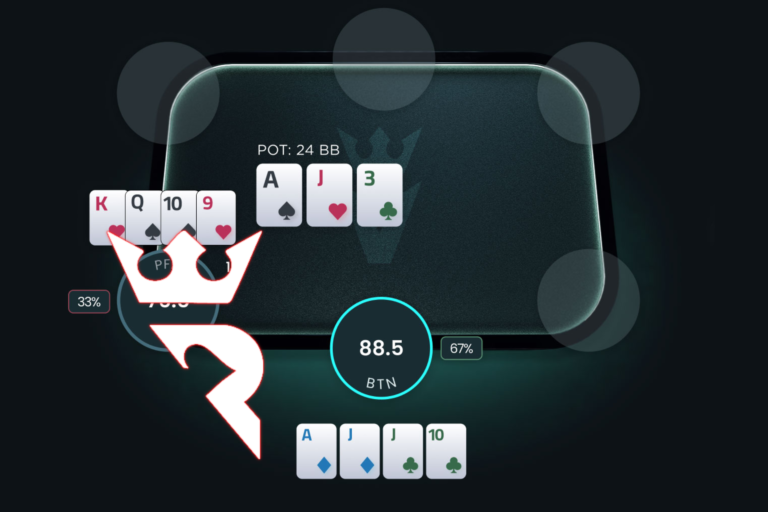
What GTO means
GTO (Game Theory Optimal) is an equilibrium strategy: a way of playing that no opponent can gain an edge against, whatever they do. The idea comes from game theory, and it entered poker alongside the programs that learned to calculate these strategies.
In essence, GTO is the mathematical foundation of the game. It gives you a strategy that holds up against any opponent and does not require you to know who is sitting across from you. Everything else is built on that foundation: once you understand equilibrium, you can deviate from it deliberately and earn extra from the mistakes specific opponents make. The two work together — the baseline gives you reliability, exploitation adds profit.
Why study GTO
Studying GTO delivers several things that translate directly into results.
You gain a reference point. Once you know what balanced play looks like in a given spot, you immediately see which way your opponent is deviating and how to use it. Equilibrium is the baseline against which both their mistakes and your own are measured.
Systemic leaks disappear. Most mistakes repeat hand after hand: defending the blinds too wide, c-betting every board on autopilot, using the wrong sizings. Study shows you these patterns as a whole rather than one hand at a time.
You build understanding, not memory. As you work through solutions you start to see the logic: why some boards call for large, infrequent bets while others call for small, frequent ones, how play changes at different stack depths, why certain hands make better bluffs than others. That carries over to spots you have never specifically studied.
Deliberate exploitation. To deviate from equilibrium against a particular player on purpose, you first need to know exactly what you are deviating from. Exploitation without a baseline is just guesswork.
Types of GTO tools
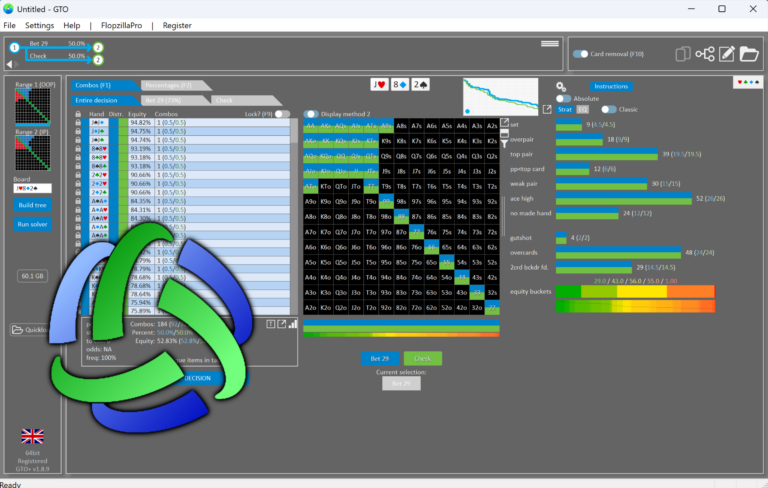
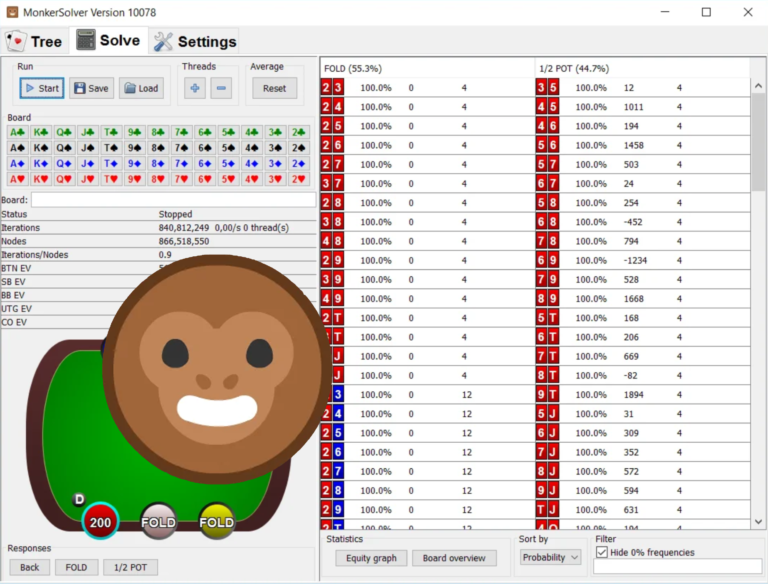
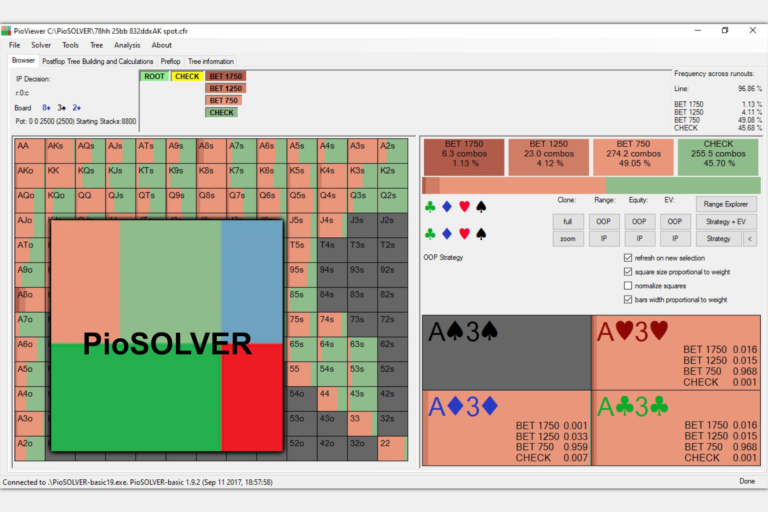
Solvers. Calculation engines that compute equilibrium for whatever spot you give them: stacks, ranges, the bet-size tree — everything is configured manually. They offer full control and let you analyze virtually any situation, including unusual ones. In return they require a powerful computer, time to compute, and an understanding of how to construct a spot correctly.
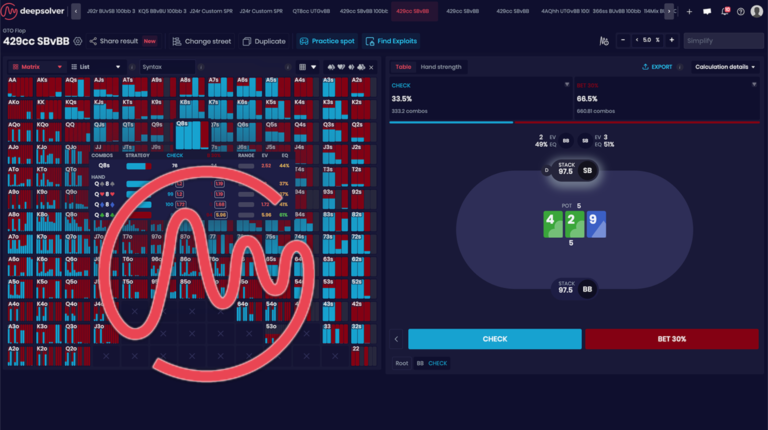
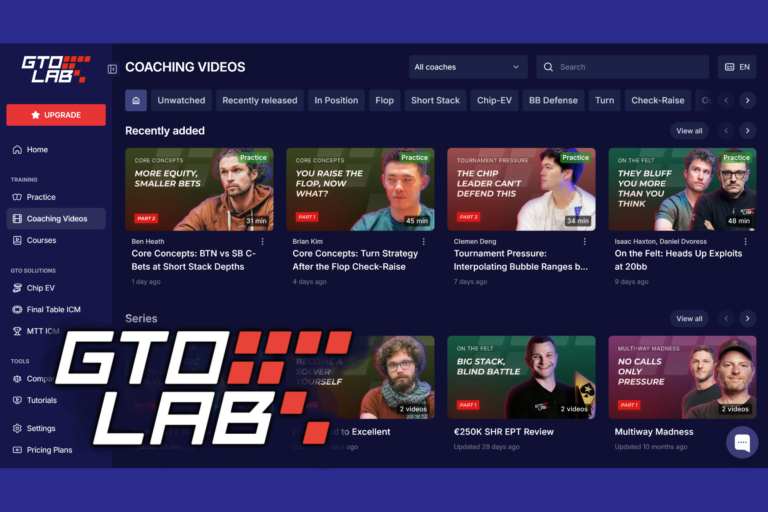
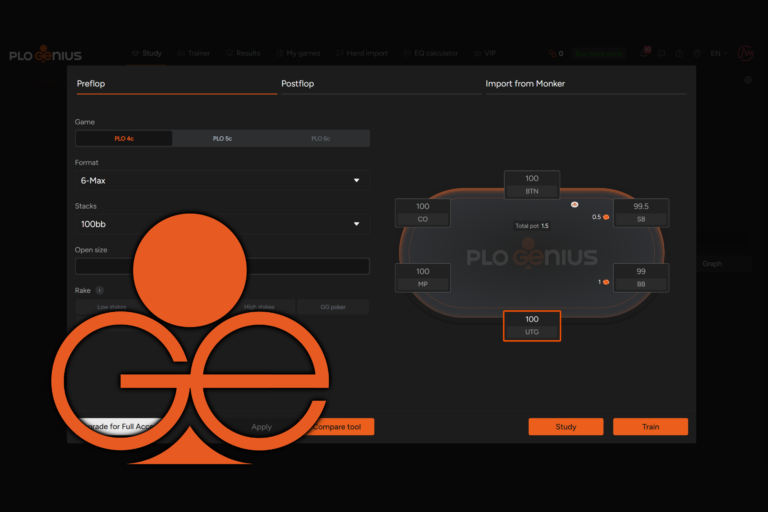
GTO platforms with presolved solutions. These work the other way around: solutions are calculated in advance and stored in a library, and you simply browse them. Pick a spot and the strategy appears in a second, with no computation and no hardware requirements. The limitation is that you can only study what the library contains. Modern GTO platforms hold enormous libraries covering most game scenarios, so they can be entirely sufficient for study even at mid to high stakes.
Trainers. Rather than showing you the solution, they test you: you are given a spot, you make a decision, and the program compares it against the equilibrium play and measures the error. This is the format that turns theory into skill — simply reading through solutions does not stick nearly as well.
Preflop tools. A separate category covering charts for opening, defending, 3-betting and other situations. Preflop is the most frequent and most easily formalised part of the game, which makes it convenient to study on its own — and for many players, working at this level is already enough.
ICM tools. For tournaments, where the value of chips does not match their count. A standard solver handles these situations incompletely — here you need software that accounts for the payout structure.
What to look for when choosing
Your format. The first and most important filter. Most tools are built around No-Limit Hold’em; for PLO, short deck and tournaments the choice narrows considerably, and proper ICM support exists in only a handful of them.
What is actually in the library. Look at the specifics: which stack depths, how many players at the table, which sizings are in the tree. A library built around 100bb 6-max cash will not help much if you play tournaments with a 25bb starting stack.
Hardware requirements. Desktop solvers are demanding on RAM, and complex postflop trees take a long time to compute. Cloud-based tools remove that question entirely — which is why they have become the default choice for most players.
The learning curve. A solver will not tell you what to study. It answers exactly the question you ask, and an incorrectly constructed spot produces a confidently wrong answer. If you have no experience with this kind of work, platforms with built-in exercises and a study plan will be considerably more useful.
Pricing model. Desktop solvers usually come as a one-time license: a larger payment, but the software stays yours. Cloud platforms run on subscriptions with tiers based on formats and stack depths. Monthly and annual billing are usually both available, and the annual plan always comes with an additional discount.
Trial period. Many tools offer a trial or a free tier. It is the best way to find out whether the interface suits the way you think — and in day-to-day work that matters more than a list of features.
Where to start
If you are just approaching GTO, a sensible sequence looks like this: start with preflop charts (fast, visible returns), then move to presolved postflop solutions on a platform, then add a trainer to consolidate what you have learned. Buying your own solver makes sense once you run into the limits of a library and know exactly which unusual spot you want to compute.
The catalogue above brings together all the major GTO tools, from cloud platforms to desktop solvers. Compare them by format, features and price, open the reviews of the ones that interest you, and pick what fits your game.