PeakGTO Review: A GTO Trainer With an ELO Rating System From Jonathan Little’s Team

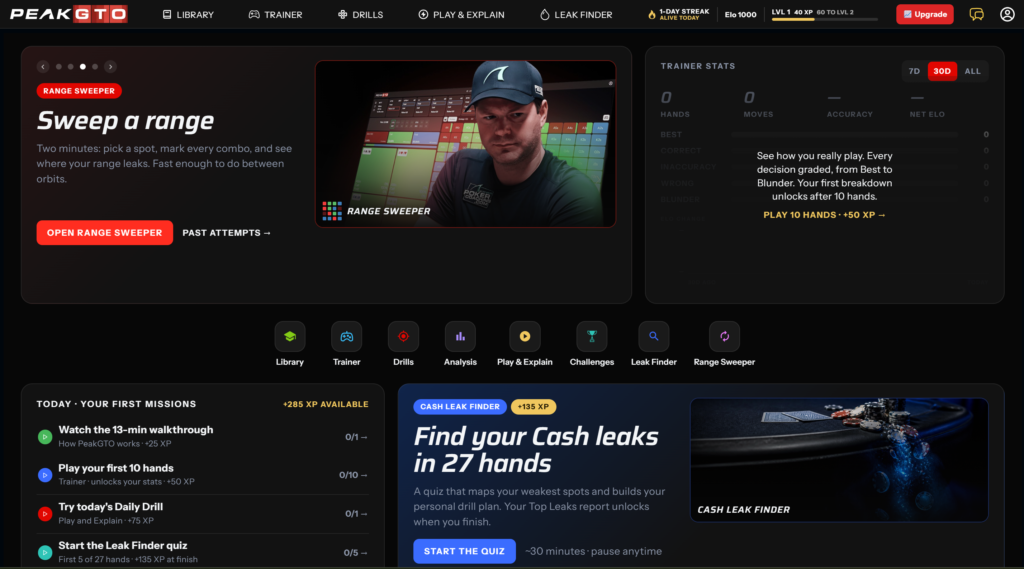
PeakGTO is an online platform for studying GTO strategy in no-limit Texas hold’em. It was developed by the team behind PokerCoaching.com, the training site founded by two-time WPT champion Jonathan Little. The platform is built around a large database of pre-solved tournament and cash game solutions, with a trainer, daily drills, mistake reports, and player ratings built on top of it.
GTO (Game Theory Optimal) is a strategy that opponents cannot gain an edge against, regardless of how they play. These strategies are calculated by solvers—programs that analyze different lines and find an equilibrium between players. A conventional solver requires configuration, a powerful computer, and time for each calculation. PeakGTO has already done this work: players simply choose a spot and study the ready-made solution.
The platform serves three purposes. It shows how to play a specific spot according to GTO, lets players practice these decisions with random hands, and calculates how much they lose by deviating from the optimal strategy. Everything runs in a browser and requires no installation.
Where the Solutions Come From and How the Platform Works
PeakGTO is not an on-demand solver but a library of precomputed results. Professional players from the PokerCoaching team defined the spots, possible lines, and bet sizes in advance, then solved them using three well-known solvers:
- preflop—with Holdem Resources Calculator (HRC) and MonkerSolver;
- postflop—with PioSolver.
Each solution has an accuracy metric. For HRC preflop calculations, this is the convergence index (CI), a number showing how close the solution is to a perfect equilibrium: the lower it is, the more accurate the solution. Standard preflop solutions in the database were calculated to a CI below 5, while ICM solutions were calculated to a CI below 2. Postflop accuracy is measured through exploitability—the share of the pot that a perfect opponent could win against the strategy. In PeakGTO, exploitability ranges from 0.25% to 0.5% of the pot depending on the size of the game tree, while low-SPR spots—where SPR is the ratio of the effective stack to the pot—are consistently solved to 0.25%.
To make the strategies easier to remember, each spot is reduced to the main bet sizes. Instead of offering a dozen sizing options on every street, the solutions retain only the sizes that genuinely matter to the strategy. For beginners, this means less noise in the data and more focus on the general principles: when to bet, when to check, and which size to use.
You only need to understand three concepts to read PeakGTO solutions:
- Action frequency. A solver often plays the same hand in different ways—for example, betting 60% of the time and checking 40%. This kind of mixed strategy is a normal part of GTO, not a calculation error.
- EV (expected value) is how much an action wins or loses on average, measured in big blinds.
- EV loss is the difference between the EV of the chosen action and the EV of the best action. If a spot is played perfectly, the loss is zero. To make mistakes easier to compare, PeakGTO converts them to a per-100-hands figure: a mistake worth −0.1bb becomes −10bb per 100 hands.
The platform is designed around a four-step feedback loop: identify weaknesses in your game, study the correct solutions in the library, practice them in the trainer and drills, and then track your progress through EV-loss statistics. Each module described below handles one part of this process.
Library: Ready-Made Strategies for Every Spot in the Database
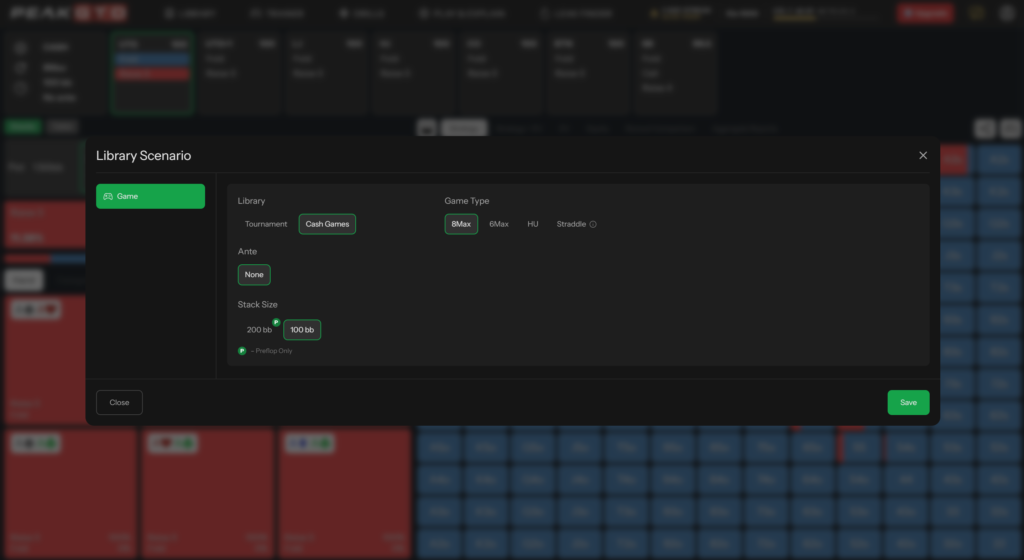
Library is PeakGTO’s central module and a reference resource containing ready-made solutions. To find a spot, simply select the format, stack depth, and sequence of actions at the table: for each seat, specify whether the player folded, called, or raised, while standard bet sizes are filled in automatically. The library then immediately displays the strategy—which hands in the range raise, call, or fold, and at what frequency.
For postflop analysis, a board is added to the preflop spot. For example, to study a 3-bet from the BB (big blind) against a BTN (button) open, the library first shows the preflop strategy and then lets you select a flop to see how often a continuation bet (c-bet) is made in that pot and which size is used. The equity/EV toggle shows what drives the decision: how often the hand wins against the opponent’s range and how much each action is worth. Suit selection lets you examine individual combinations within a hand, such as how a suited combination differs from an offsuit one on a particular board.
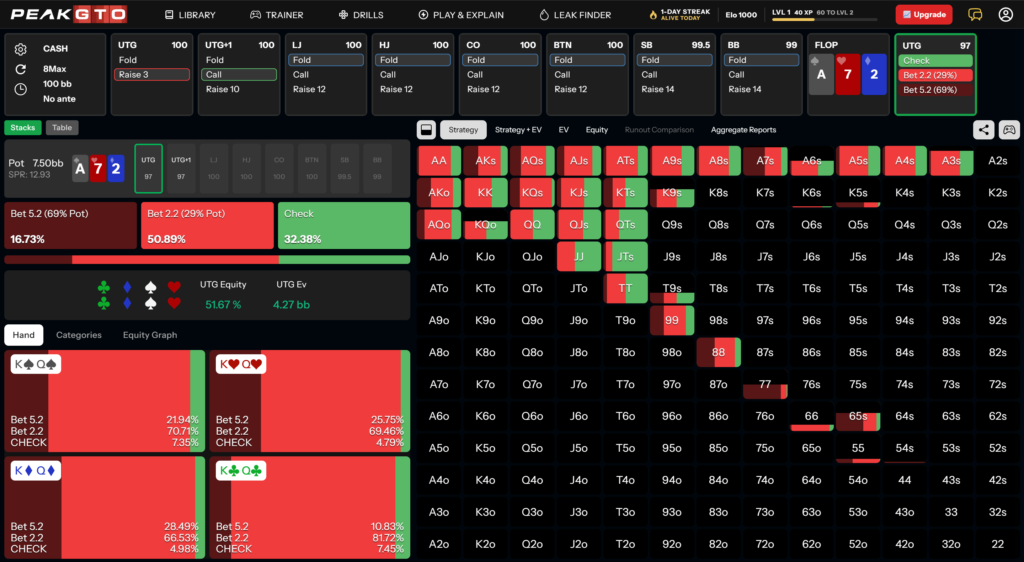
The practical benefit of the library is that it takes only a few seconds to answer the question, “How should this spot be played in theory?” After a session, you can immediately compare a difficult hand with the solver solution instead of guessing whether you played it correctly. The developers recommend looking for general patterns in the solutions rather than memorizing every hand: which hands bet more often on which boards, and how frequencies change with position or stack depth.
Available Formats and Stack Depths
PeakGTO’s database is considerably stronger for tournaments than for cash games:
- 8-max tournaments (live and online), preflop: 18 stack depths—100bb, 80bb, 60bb, 40bb, 30bb, 25bb, 20bb, 15bb, 12bb, 10bb, 9bb, 8bb, 7bb, 6bb, 5bb, 4bb, 3bb, and 2bb.
- 8-max tournaments, postflop: 80bb, 60bb, 40bb, 30bb, 25bb, 20bb, 15bb, 12bb, and 10bb.
- Cash games, preflop: 200bb and 100bb.
- Cash games, postflop: 100bb.
The free plan also includes heads-up preflop ranges. Short-stack solutions are particularly important for tournament players: decisions involving shoves, calls against all-ins, and resteals arise most often at 10–20bb, and these stack depths are covered in detail.
ICM Spots and Exploitative Ranges
The paid plans add two sections to the library. The first covers ICM spots. ICM (Independent Chip Model) converts tournament chips into real monetary value while accounting for the payout structure. Because of ICM, correct play on the bubble or at a final table differs significantly from play early in a tournament: many all-in calls that are profitable in chips become unprofitable in monetary terms. PeakGTO includes solutions for bubble play, final tables, and push/fold spots—short-stack situations with only two options: go all-in or fold.
The second section contains exploitative ranges designed for playing against opponents with clear strategic imbalances. A GTO solution assumes a perfect opponent, but at real tables, many players call too often or, conversely, fold too much. These ranges show how to deviate from equilibrium when you know an opponent’s typical mistake. It is up to the user to decide whether to make this adjustment against a particular player.
Trainer: Test Your Decisions and Track EV Loss
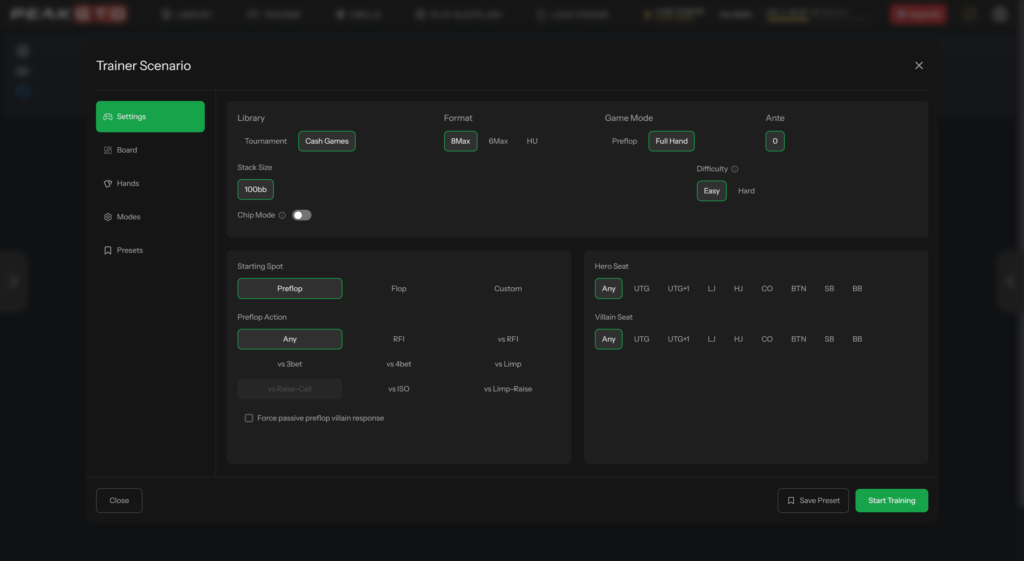
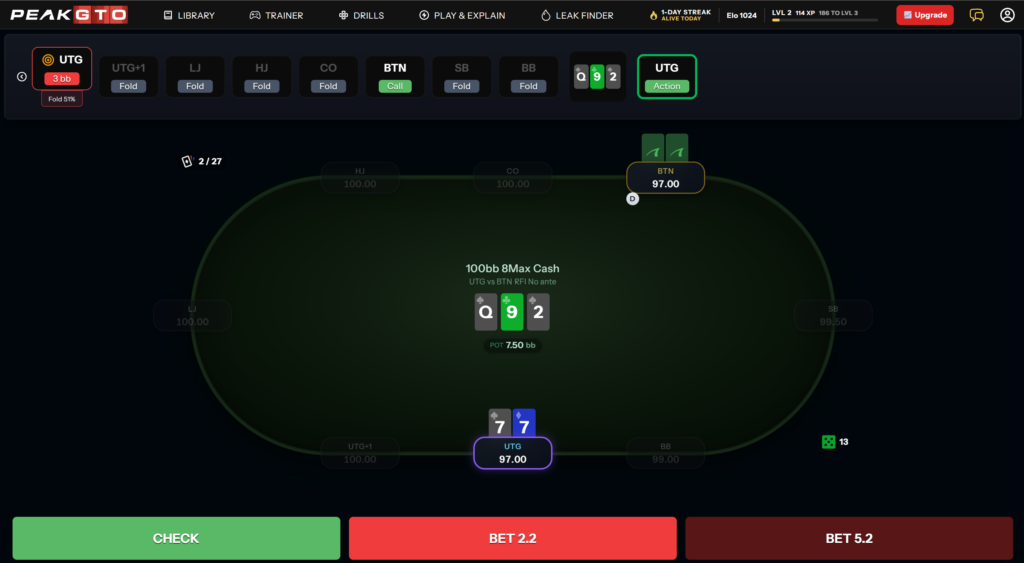
Trainer turns the study of solutions into practical training. First, you set the scenario parameters: the format, hero’s and the opponent’s positions, the point at which the hand begins, and the actions taken beforehand. For postflop training, you can also specify a particular flop. Once launched, the trainer deals random hands that match these conditions and asks you to choose an action.
After each choice, the trainer shows how frequently the solver selects each action in that spot and calculates the resulting EV loss. If the hand does not end in a preflop all-in, it continues to the flop, where another decision must be made. The trainer’s database contains more than 20 million scenarios, so the same hands rarely repeat.
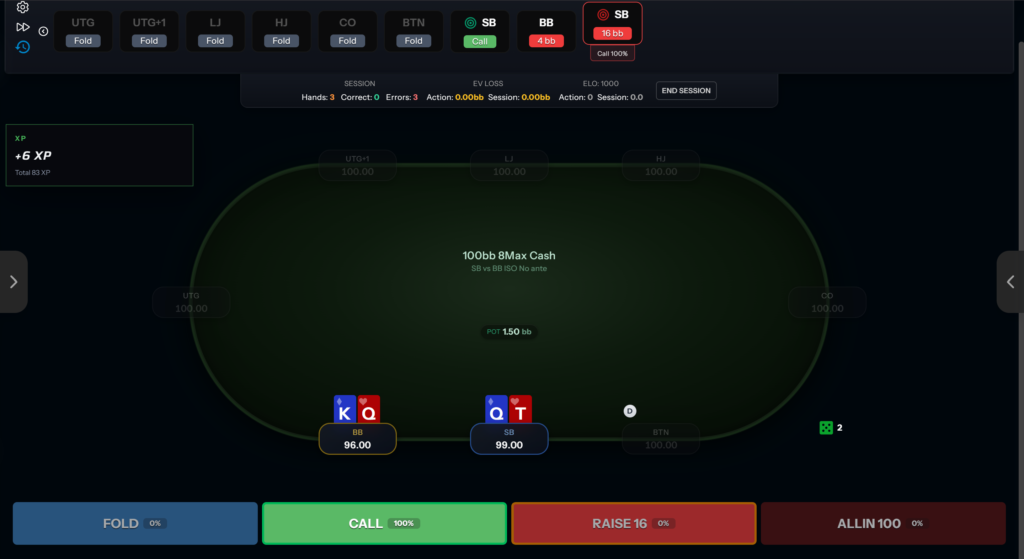
For beginners, the trainer is useful because it requires them to apply the same rule dozens of times across different hands. The EV loss immediately shows how costly a mistake was: an inaccuracy in a mixed-frequency spot may cost only a fraction of a big blind, while folding a strong hand costs much more. This helps distinguish minor inaccuracies from genuinely expensive mistakes and focus your time on the latter.
Daily Drills and Collections From Professional Players
Drills are ready-made collections of spots created by professional PokerCoaching players. There are more than fifty of these collections, each dedicated to one specific area of the game. Some drills also include video reviews from coaches.
Drill of the Day is a short training session focused on one topic. Each drill covers a single concept, so it takes only a few minutes and does not require you to decide what to study that day. On the free plan, a new Drill of the Day is available once a week; paid plans provide unlimited access.
For beginners, drills solve the main problem with studying GTO independently: not knowing where to start. The coach has already chosen the topic and selected suitable spots, while regular short sessions provide steadier progress than occasional multi-hour study sessions.
Leak Finder and Statistics: Where You Lose the Most EV
Leak Finder is a module for diagnosing weaknesses in your game. In poker, “leaks” are systematic mistakes that regularly cost a player money. The module asks you to play 25 hands from a curated set of spots involving different positions and stack depths. It then compares each of your decisions with the solver’s choice and generates a report: EV losses are broken down by position, street, and type of spot, then sorted from most to least costly.

For example, the report might show that you lose the most EV through postflop bet sizing in BTN-versus-BB pots, while your opens from early position are nearly error-free. Each identified mistake is linked to a drill, so you can start working on it immediately after the assessment.
The Analysis section collects EV-loss data after every training session, broken down by type of spot and position, with recommended drills for each weak area. This data shows which mistakes you have already corrected and which ones continue to recur from one session to the next.
It is important to understand that Leak Finder uses the platform’s own scenarios, not hands from poker rooms. You cannot upload your hand histories and analyze them in PeakGTO, so the report reflects how you handle standard training spots.
ELO Rating and a Monthly Competition Against a Coach
PeakGTO’s ELO rating is a numerical assessment of your decision-making accuracy in the trainer. It is calculated from EV losses: the greater the losses, the further your play is from GTO and the lower your rating. As your losses approach zero, your rating increases. The rating is also available on the free plan.
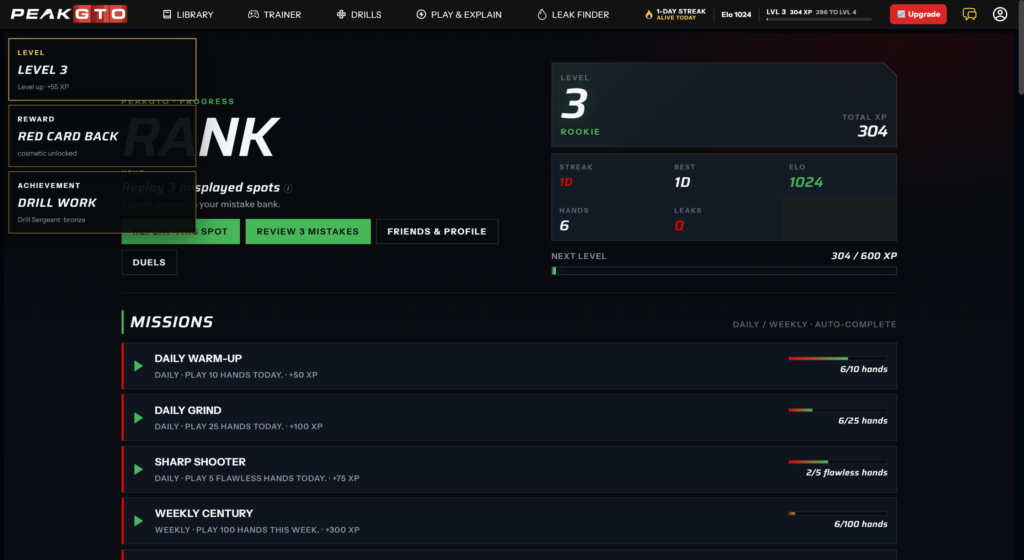
Monthly Challenge works as follows: every month, the team publishes 25 real hands played by one of the PeakGTO coaches. Participants play through the same spots, compare their EV losses with the coach’s result, and appear on a shared leaderboard.
For beginners, the rating and competition provide a clear way to measure progress. Studying GTO takes months, and without measurable results, it can be difficult to tell whether the training is working. Rating growth and comparison with a coach show your improvement in numbers.
Integration With PokerCoaching Courses
PeakGTO is closely integrated with the PokerCoaching training site. Jonathan Little’s Tournament Masterclass lessons are structured so that after a concept is explained, the student immediately moves on to PeakGTO drills covering the same topic. This reinforces the lesson’s theory through practice in matching spots. Masterclasses, structured courses, and live coaching sessions are included in the separate PokerCoaching + PeakGTO plan.
For beginners, this combination is useful because the solver solutions come with explanations: the course explains why the strategy works the way it does, while PeakGTO lets you practice it.
Compatibility: Games, Formats, and Devices
- Game: no-limit Texas hold’em only. The database does not include Omaha, short deck, or mixed games.
- Formats: 8-max tournaments (live and online), cash games, and heads-up preflop ranges. Solutions have not been calculated separately for 6-max tables.
- Postflop: solutions are calculated for heads-up pots. The database does not include postflop spots with three or more players.
- Stack depths: tournaments range from 100bb to 2bb preflop and from 80bb to 10bb postflop; cash games include 100bb and 200bb preflop, but only 100bb postflop.
- Devices: the platform runs in a browser and requires no installation. The official website does not list any dedicated mobile apps.
- Poker rooms: PeakGTO does not connect to poker rooms, display a HUD, or import hand histories.
The usage rules also deserve special attention. PeakGTO is a study tool intended only for use between sessions. The developers explicitly prohibit opening it while playing, and poker rooms and casinos treat this as real-time assistance (RTA), which can result in penalties up to and including account suspension.
Getting Started With PeakGTO
All you need to use PeakGTO is a browser and an internet connection. There is no separate trial period: the free plan serves this purpose and has no time limit, while paid plans come with a 30-day money-back guarantee.
- Create a free account. Registration is completed through a PokerCoaching account on the PeakGTO website, and no credit card is required.
- Open the preflop library. Choose the format and stack depth you encounter most often in your own games, such as tournaments at 20–40bb or 100bb cash games.
- Practice preflop. In the trainer, select the same positions you studied in the library and play several dozen hands while monitoring your EV losses.
- Try postflop training. The free plan includes five postflop hands per day and a weekly Drill of the Day—enough to understand how the postflop solutions work.
- Upgrade to a paid plan if necessary. A subscription unlocks Leak Finder, where a 25-hand assessment shows which topics you should work on first.
Plans and Limitations
PeakGTO is sold as a subscription. The free Starter plan has no time limit and includes the entire preflop library, the preflop trainer, five postflop hands per day, and weekly drills. The PeakGTO plan removes all limits and unlocks the complete postflop library, ICM spots, exploitative ranges, Leak Finder, statistics, and Monthly Challenge. The PokerCoaching + PeakGTO plan adds PokerCoaching masterclasses, courses, and live coaching sessions. Subscriptions can be paid monthly or annually, with the annual option offering substantial savings.
A detailed description of the plans and prices is available on the product page.
Conclusion
PeakGTO gives beginners direct access to solver solutions without installation, configuration, or lengthy calculations. Library answers the question, “How should this spot be played in theory?” Trainer and Drills turn those answers into practice, while Leak Finder, statistics, and the ELO rating show which mistakes cost the most EV and how your decision-making accuracy changes over time. The platform is strongest for tournaments, with 18 preflop stack depths and a dedicated ICM section. Cash game players and fans of other poker variants should check in advance whether their formats are covered by the database.
The best way to learn PeakGTO is gradually: start with preflop on the free plan, then move on to postflop solutions for the most common spots, and only after that study ICM and exploitative ranges. Regular short sessions with Drill of the Day and EV-loss tracking produce more consistent results than trying to study the entire database at once.

Featured software




Latest posts
-
 GGPoker Bans Third-Party Poker Software: Five New Security Measures Oct 18, 2026
-
 Table Wizard Review: Table Organization and Automated Session Analysis Oct 17, 2026
-
 GTOBase Review: Ready-Made GTO Solutions and Hand Analysis Oct 15, 2026
-
 Simple Postflop Review: A GTO Solver for Heads-Up Pots from Preflop to River Oct 14, 2026
-
 Simple Preflop Holdem Review: GTO Preflop Strategies for Any Table Oct 13, 2026
All the poker software you need, gathered in one place. Exclusive discounts, bonuses, latest news and updates.
Join now