MDA Demon
A mass data analysis platform that compares pool frequencies with GTO bot solutions and shows which pool deviations can be exploited for profit. Read full review
Screenshots
Pros & Cons
| Pros | Cons |
|---|---|
| Pre-calculated data | NLHE only |
| No own database needed | Cash games only |
| GTO bot benchmark | No mobile app |
| EV of deviations | Narrow stake range |
| Fish and regs separated | No analysis of own hands |
| Runs in the browser | |
| Free access, no card |
Description
MDA Demon is a platform for mass data analysis (MDA). The term refers to studying poker not through individual tricky hands but through millions of hands at once: a large dataset shows how the pool — all the opponents at a given stake in a given room — plays on average. Pool mistakes repeat from hand to hand, so knowing these average habits translates into profit.
Mass analysis usually requires a personal database of millions of hands, a powerful computer, and slow tracker queries. In MDA Demon, everything is calculated in advance: the data has been collected, processed, and mapped to the nodes of the game tree, so the user only needs to pick a spot to see the numbers right away. No installation is required — the platform opens in a browser on any operating system.
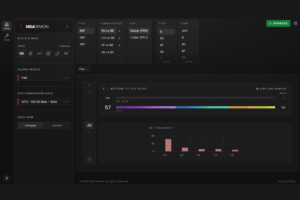
The platform’s defining feature is a constant comparison against a baseline. Next to real players’ frequencies, it shows the frequencies of GTO bots: hands the developers generated from their own solver calculations rather than rough estimates. The gap between the two lines is the pool’s deviation — a spot where opponents play differently from what the optimal strategy prescribes and where exploitative play pays off.
The game tree is navigated step by step: pot type (single-raised, 3-bet, or 4-bet pot), a two-position formation (for example, BTN vs CO), side — preflop aggressor or caller — and then actions on the flop, turn, and river along with bet sizes. Each node shows range composition by hand category (from air to a full house), bet frequencies by size, and responses to bets, plus an automatic calculation of how many big blinds exploiting that deviation earns.
Weak players and regulars are studied as two separate pools. This matters in practice: bluffing and bluff-catching against fish calls for a different approach than against solid regs, and the platform shows both pictures. The format is handy when preparing to move up in stakes or building a game plan for a specific room.
Pricing
-
Free — $0. The platform interface and one dataset: weak players at NL50 on GGPoker.
-
Entry — $39. All game-tree nodes and formations, GTO bot datasets, 64.4 million NL50 cash hands and 53 million NL100 hands.
-
Pro — $79. Full access to the data library: 64.4 million hands at NL50, 53 million at NL100, 51.7 million at NL200–NL500, and 11.3 million at NL1000–NL10000.
The plan can be upgraded or canceled at any time with no extra fees.